The door to the market is shuttered, its insides swept dark. I keep looking beyond the glass, wondering where everything has vanished. The signs on the building’s exterior have been stripped away. All that remains is a ghost facade, faint silhouettes of Chinese characters: It was once the Wudaokou Costume Market.
A Baidu search tells me that the wholesale market — where three floors of vendors once sold cheap jewelry, knockoff Adidas track pants, imitation Diesel jeans, graphic t-shirts adorned with poorly translated English, handbags, and more — was closed at the end of January this year. This is bad news. I had planned to spend my first afternoon in Beijing bargaining for jewelry. This ring for twenty-five RMB? That’s far too much. Let’s do ten.
I lived in this part of Beijing before while attending sixth grade at a school near the outskirts of the city, yet little is familiar. There’s no trace of the market so visceral in memory: the first floor that sold electronics; the second a maze of purses lined neatly on hangers, vendors shouting out increasingly favorable prices as you walked farther away. A store closing is expected after leaving a country for six years, but something about this closure is so shockingly urgent, almost hasty, as if the city was in a rush to rid itself of this space, like ripping a splinter from flesh.
Mao Zedong once said that to be a builder of a new world, one must be a critic of the old world. China is diligently razing its old world; now, only three of Beijing’s once-ubiquitous wholesale markets remain, all of which cater largely to tourists and foreigners. The market closures are part of the city’s efforts to eliminate non-essential businesses, which are dubbed “big city ills.” Vendors are forced to relocate to marketplaces that can be up to an hour away by train from Beijing, where they often struggle to maintain business. Nonetheless, the empty wholesale markets in will soon contribute to the city’s new face. Many will be reconstructed as high-end shopping malls or cultural centers.
I’ve witnessed China’s rapid modernization in the form of Beijing’s changing landscape. The city looks futuristic now — the twisting CCTV building, gleaming high-rises of the financial center, the high-speed trains whispering through the country. I find a different space each time I step off the plane: One visit, there’s a cluster of hutong, the next, a new shopping district. One visit, there’s rickshaws, on another, a new subway line. One year, I see my grandfather, another year, I don’t.
In Beijing, I pass as a local until I start speaking, so I don’t speak, just take a bus to a nearby park — Yuanmingyuan. In the park are the ruins of a palace, burnt by the British and French during the Opium Wars. This city is different but its rhythms are familiar: I listen to a group of schoolchildren laughing in front of the cracked marble, to the swans honking in the ponds, to the sway of a migrant worker’s broom as she brushes rainwater toward the side of the street, only to watch it stream down again.
Ancient Chinese architects were obsessed with balance, harmony, and hierarchy, so it makes sense that the hutong of Beijing — traditional neighborhoods constructed during the Yuan dynasty — cocoon the Forbidden City, stretching around the palace like honeycombs. In imperial China, dignitaries and friends of the emperors lived in the hutong closest to the palace, while the poor remained in the outer rings.
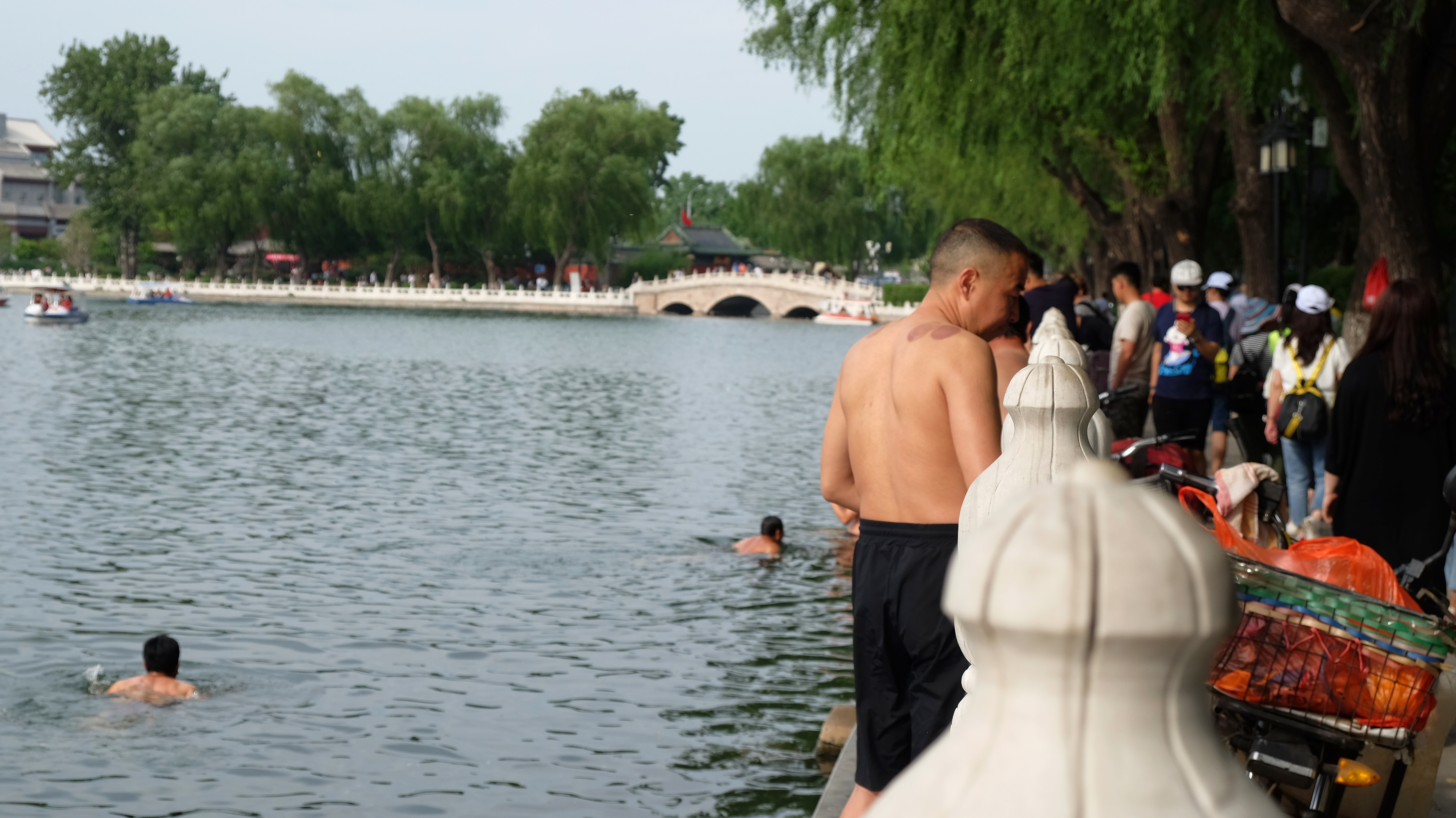
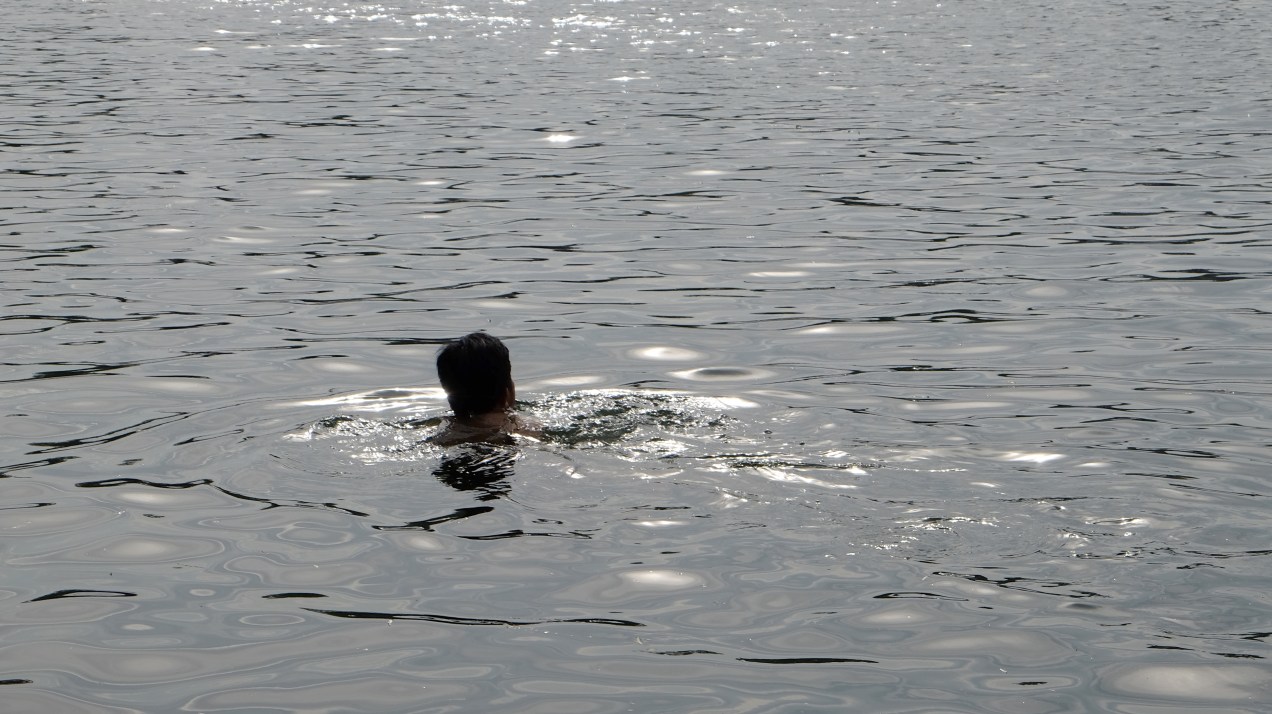
Residents gather on the shore of Houhai after swimming. 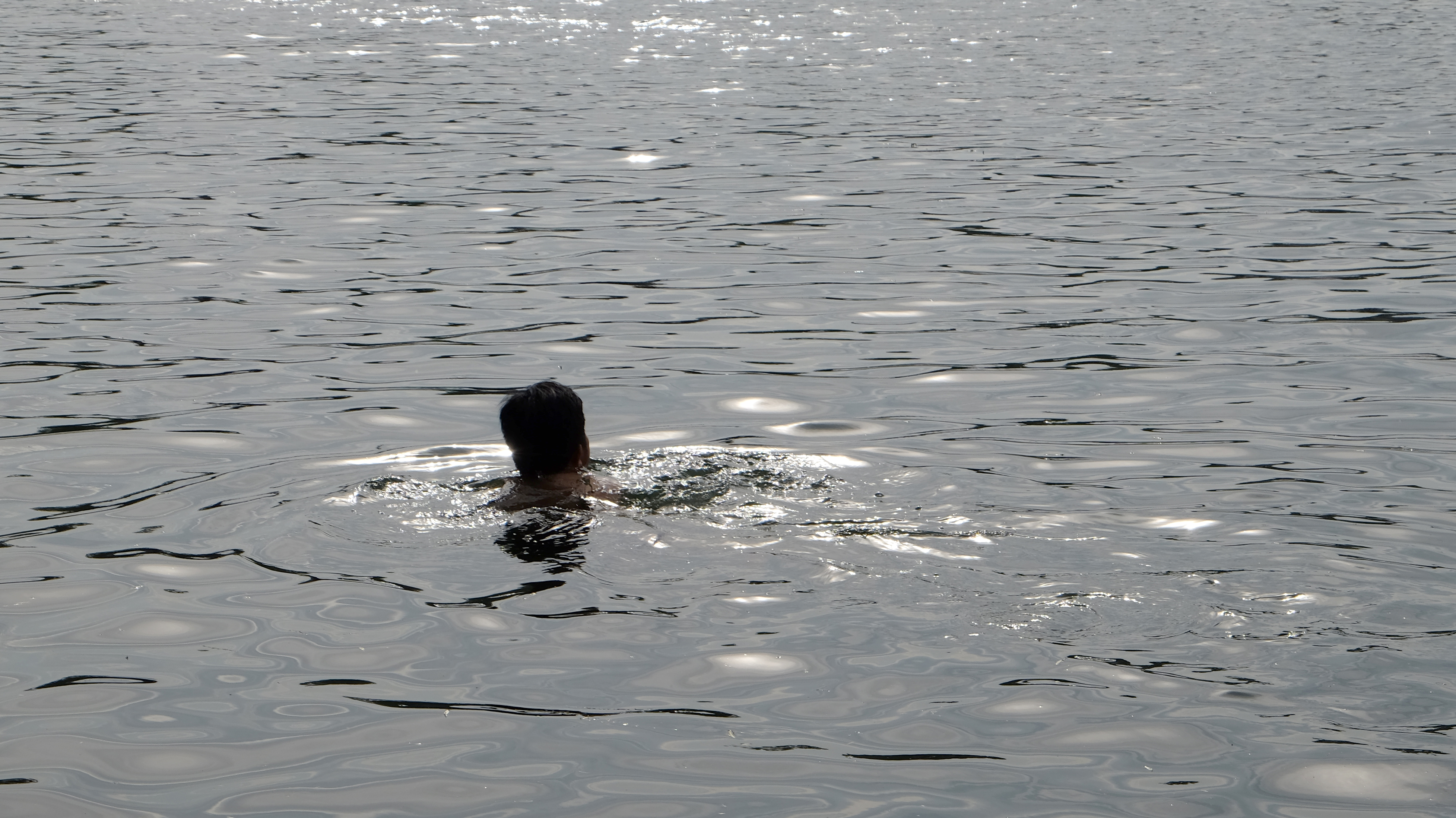
A man swimming in Houhai. There were signs that warned visitors against swimming, as the water is not clean.
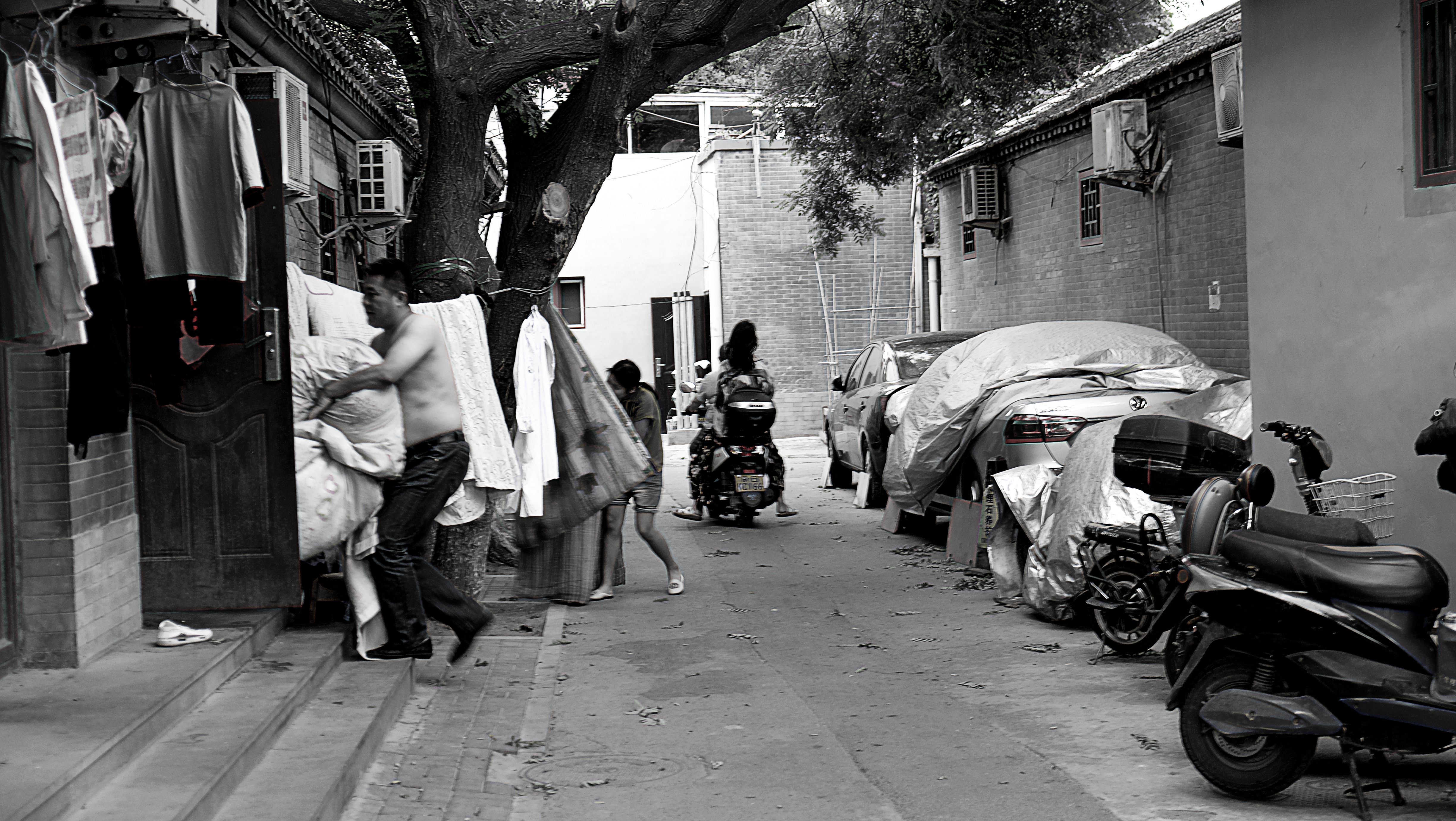
I’ve always thought that hutong are the best places to visit in Beijing, as they are some of the most social, community-based neighborhoods. Today I’m visiting Nanluoguxiang, a hutong near the old Drum and Bell Towers. A group of elderly women bring stools to the street, gossiping as their little dogs yap at each other. It’s windy, and, as a breeze starts to blow away linens hanging outside a home, a couple rushes outside to save them before they fly away. Later, at sunset, a dozen men cluster near the edge of Houhai, their bare backs covered in cupping marks. They wade into the lake and begin swimming.
Smash the four olds, the Chinese revolutionary saying goes. Old customs, old culture, old habits, and old ideas. Sweep away these ghosts and monsters.
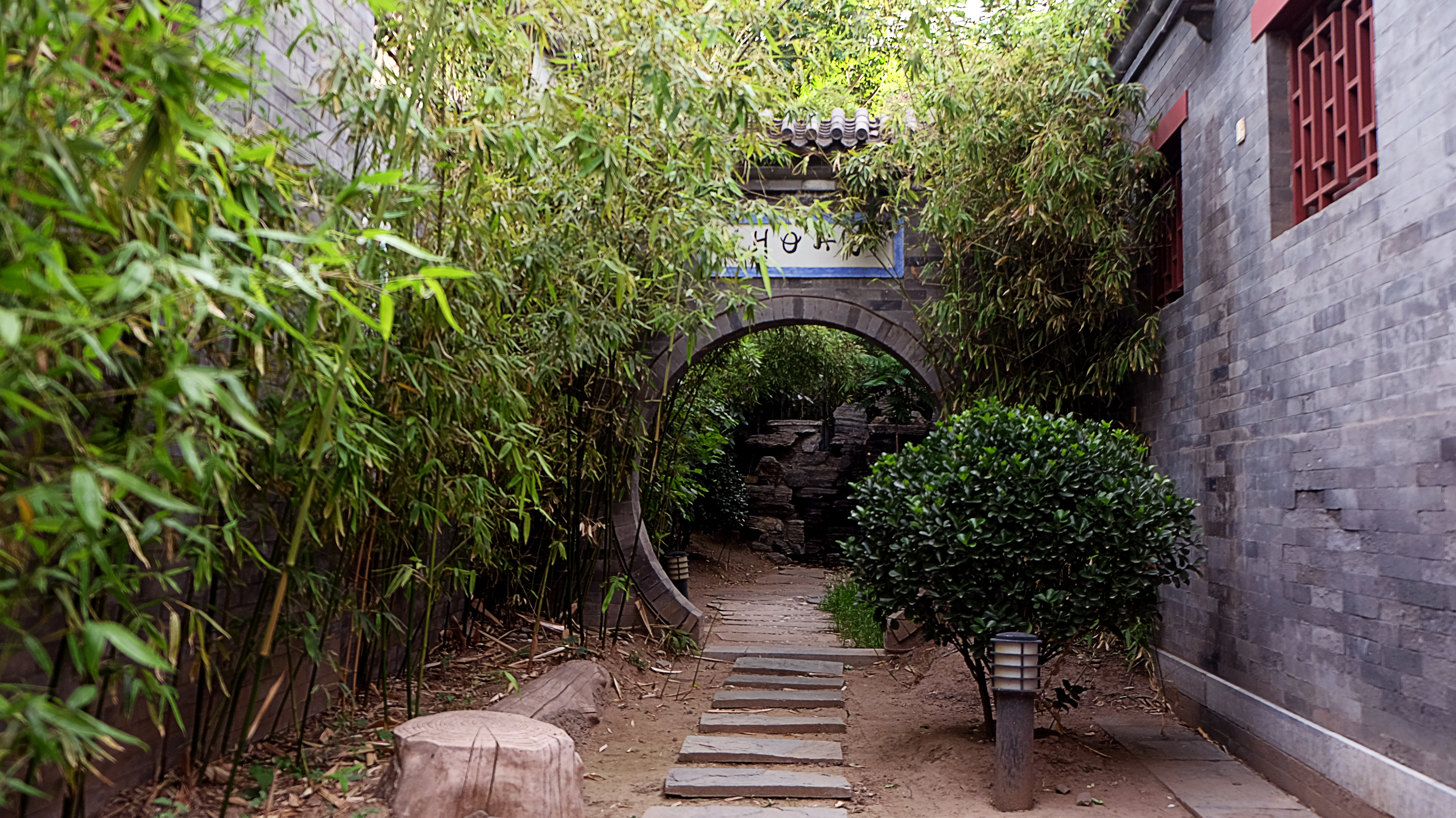
The city had set out to demolish this neighborhood to make room for a new project, “Time Cultural City,” a themed shopping plaza. They decided to leave it after facing significant local protest. Mainly, the hutong survives because it is economically feasible: While the side streets contain the homes of local residents, who are generally elderly and lower income, the main street contains bohemian bars and cafes hidden in siheyuan courtyards, where foreigners, tourists, and young people drink and socialize.
The rest of Beijing’s hutong — for which profit-making opportunities are more scarce — don’t meet such favorable fates. Hutong homes — many of which have been passed down for generations — are often marked for demolition, and residents have no choice but to move to low-quality high rises outside the city.
I stop by a quiet rooftop café, where plants surround every table and cats wander among the patrons. There’s something about traveling alone that forces you to pay attention to everything a place presents about itself, how it chooses to share its history. I can’t help but sense the artifice in this hutong, so different from the city beyond its walls. The hutong is a calculated tableau of the past; the rest of the city lunges into the future.
The iconoclast artist Ai Weiwei, a controversial figure in China for his protest-inspired artwork, is notorious for his piece Dropping a Han Dynasty Urn. The work is a set of three photos: The first shows Ai clutching a genuine Han urn, considered a priceless antique; the second has the urn in midair, falling to the ground; the third shows the urn smashed into pieces at his feet. It suggests that what we consider valuable is subject to change at any given moment — that this change can be sudden, violent.
Beijing has a complicated relationship with its history, and it is perhaps more interested in erasing its ghosts and monsters than bringing them to light. Still, Beijing has remarkable control over the narrative of itself it presents to outsiders, something that becomes most evident to me in Tiananmen Square.
The guidebooks say to avoid the crowds at Tiananmen, but it’s hard to find many in its expansiveness. I am always struck by the vastness of the square, even by its overt displays of political power. The positioning of government buildings in front of a symbol of imperial China is far from subtle. Children wave Chinese flags; families snap selfies in front of Mao Zedong’s portrait.
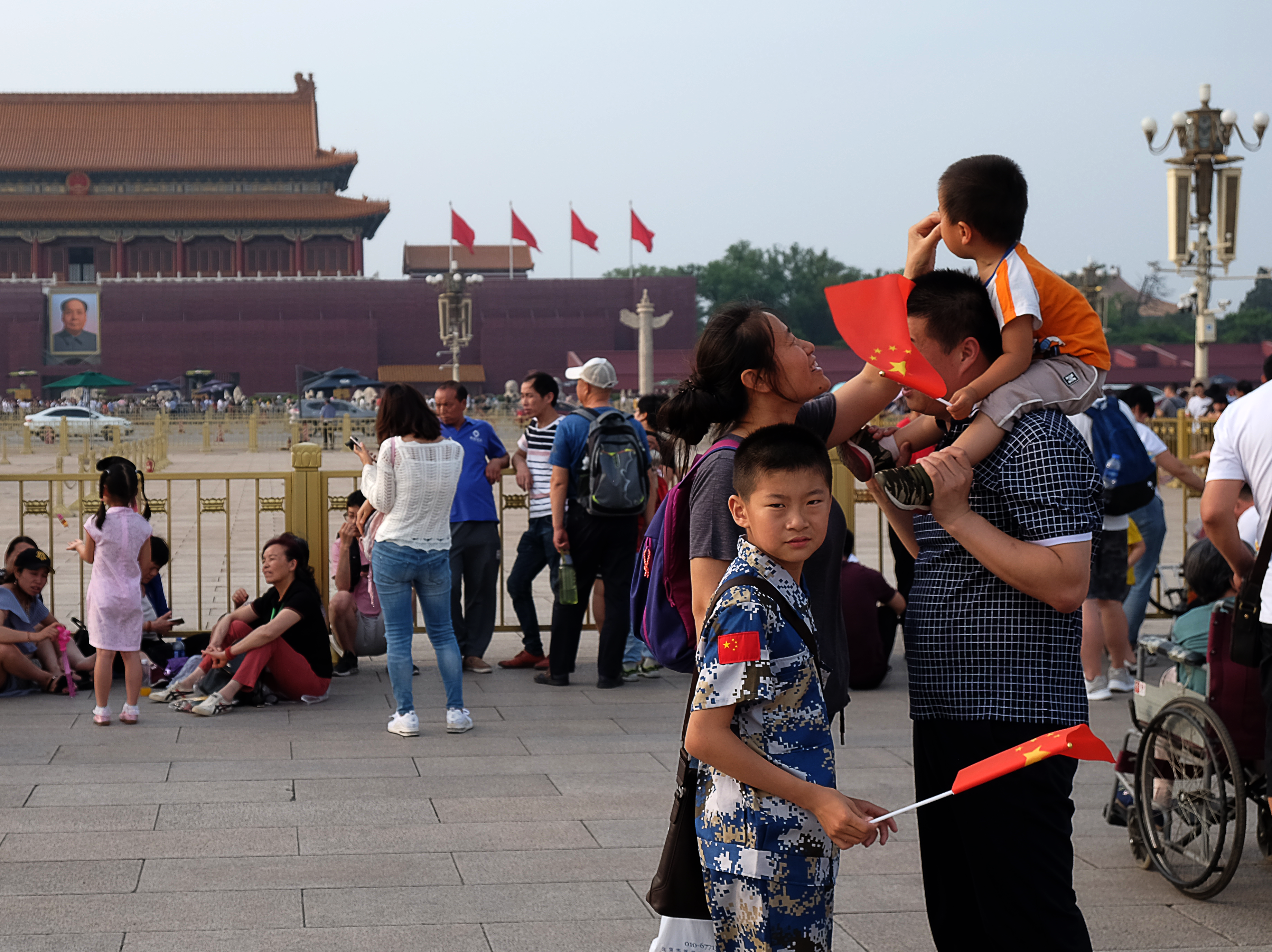
It’s an uncomfortable space. I am trying to find ways to document what the city chooses to forget. I am trying to find ways to photograph why and how it makes me uncomfortable — this gate of heavenly peace that, for much of the world, represents the political, controversial, and even brutal — when a couple guards approach me.
“Mei nü, I saw you taking photos of us,” one says, stiff in his uniform. “You are not allowed to do that. We cannot be in any photos.” He watches over my shoulder as I open my camera, hit Delete.
“I’m sorry,” I say. “I didn’t realize.” Behind me, against the dusk, a worker removes a broom from her cart and starts sweeping.
 Notes from Harbin