FORGETTING EVERYTHING

On the first day of our program, our teachers tell us not to be shocked if anyone Chinese tells us, “You’ve gotten fatter.” This is not considered rude in China, she explains, merely a habitual way of greeting a friend or acquaintance.

No culture shock here. At family banquets in China, which my sister and I would be customarily flown in every few years in our childhood to attend, I grew used to the aunties, whose faces I often can’t recall, telling me how big, how fat I’ve become. They would make these remarks amiably, often smiling, counterintuitively filling my plate with more needle-boned fish, pinching the parts of my stomach that have changed. Any foreigner should know Chinese people are not like Americans; they are willing to point out anything different.


A classmate and I visit a local wholesale market to hunt for cheap clothing. We’re both Asian American. At a small shop selling sundresses, the vendor manning the stand notices our accents, the way we can’t seem to curl our tongues to pronounce r words.

She says, “You are not from here.”

We think only of bargaining. We explain that we’re foreigners, Americans actually. We traveled so far to look for affordable clothing. Can you give us some better prices? A little cheaper, maybe?

The vendor is not interested in prioritizing business. “Americans? Why do you look like that?” She steps closer, studying our non-American faces. Another vendor joins her. They pinch our clothing, look down our shirts, move their faces closer to our skin, still giggling at each other, Why do they look like that?

“We’re Americans,” we repeat as they flock us, though I’m unsure whom we are addressing. We reach for the bead curtain hanging over the store’s exit. When we duck out, they point after us: Are you sure they’re not Chinese? Other vendors come out to look at us, looking after our running silhouettes.


Mandarin was my mother tongue. I grew up speaking it until I didn’t. It feels odd to relearn a language that I once knew so seamlessly, to say a word and realize that I can no longer pronounce it.

In my language program, we’re often paired with partners or classmates for different classes. A portion of the class is devoted to reviewing and pronouncing new vocabulary words. Our teacher holds up words on a flashcard, we read them back as accurately as possible.

I sense there are different standards for different students. The teachers are more forgiving toward mistakes made by non-Asian students. In a class with mostly white students, I pronounce a word slightly incorrectly. The teacher singles me out.

“Wrong,” she says, “say it again.”

I say it.

“Repeat it,” she says, “again.”

I’ve been asked by multiple strangers if I plan on returning to guonei, or “the Mainland,” after college. I explain to them that I was born in the United States. I’m an American. They question me further. How, then, do I look Chinese? Some strangers in China don’t bother me with more questions. Instead, they get upset, hurl insults, and insist that I am not American, just delusional, arrogant, and Chinese.

In Mandarin, there’s a phrase, 忘本 (wangben) that means “forgetting everything.” It’s used to signify the worst kind of forgetting, a kind similar to amnesia, a kind hard to forgive — one that makes it hard to recall what you’ve lost.

I hear this for the first time on a taxi ride to the Beijing airport. A particularly curious driver keeps asking me which Chinese CEOs I admire, so I tell him I don’t know many, I’m an American.

Laughing, he says, “Then you have really wangben.” For some reason, I felt guilty. I feel this guilt when overheard speaking English on the bus; when not remembering the faces of my relatives; when traveling to another country to relearn my mother tongue; when looking at my language teacher as I repeat a word I used to know, as she reiterates, Again, remember, again.
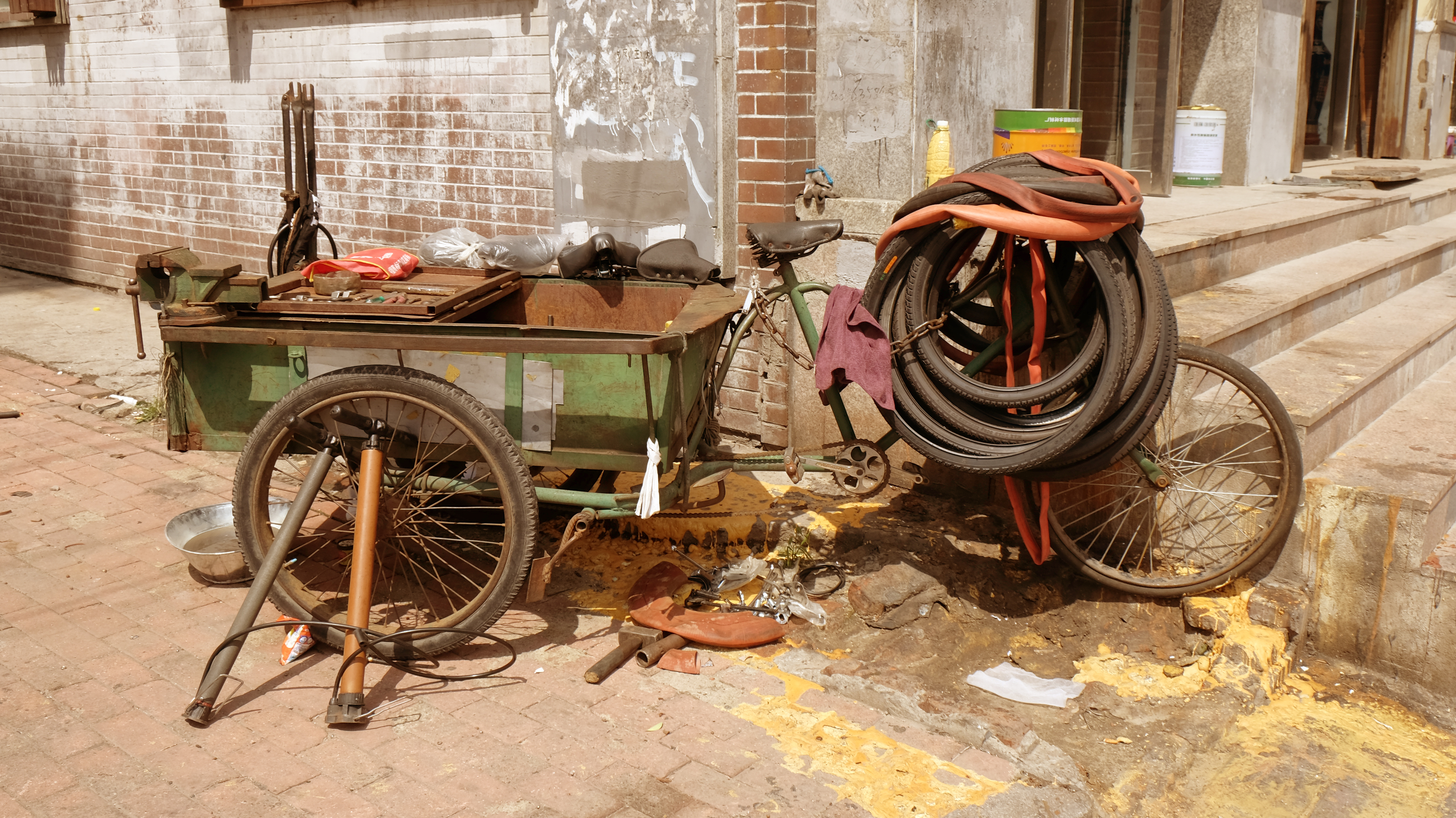

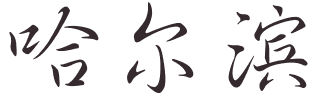
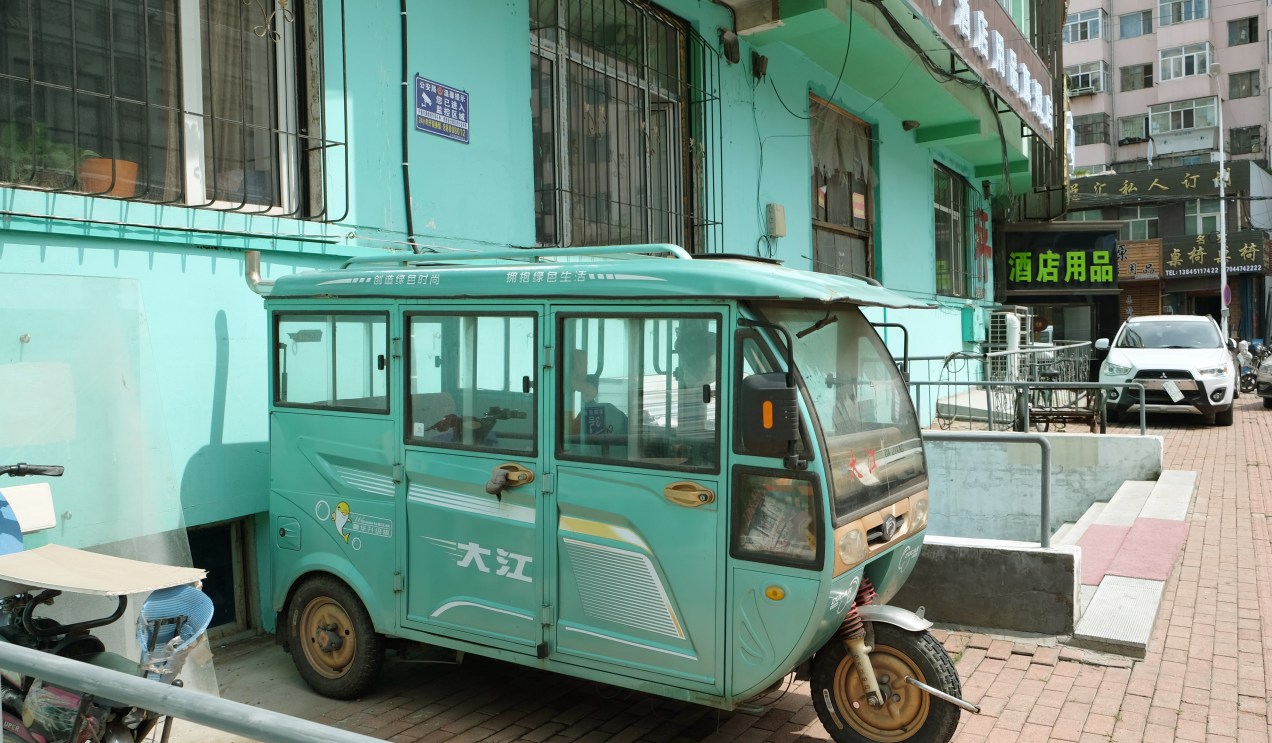
A cart in the Daowai district of Harbin, where Chinese once lived segregated from Western/Russian residents.

We Asian Americans, Chinese Americans, and other hyphenated Americans are said to have the advantage of having one foot in each nation. The downside to this is that we flounder, struggle to find our balance. We are never rooted to one cohesive identity. 

I don’t find comfort in a purely American identity. America is the white parent asking if I eat dog at home. America is chink, is love me long time. America is the elementary school teacher telling me to speak normal. Not in Chinese. America is my parents calling my white friends “American,” my Chinese American friends “Chinese.” America is another child staring at me from the front of the bus, pulling his eyes into slits, grinning.

In China, I can’t deny that I feel less exotic, foreign, and interesting and more alien, the result of a ghastly intercultural experiment. Even when I feel this way, I don’t find much comfort in the country that claims my nationality, that implicitly taught me — through years of racism, internalized, systemic, and overt — that speaking Chinese is useless, so I should just forget it. 


Most Chinese Americans who have been to China believe that ABCs — Chinese slang for “American-born Chinese” — receive different treatment than foreigners who look visibly foreign. I am grateful for the ability to slip through crowds unnoticed, to ride the subway without strangers snapping furtive photos of me. Nonetheless, when Chinese people breach the topic of nationality and identity, that’s when ABCs are paid the most attention.

“If you’re American, then how do you look Chinese?” The origin of this question is becoming clear. For Chinese nationals, who have had the idea that a nation must be “ethnically harmonious and unified” fed to them for decades, one’s nationality is inextricably tied to race. Thus, for them and for many others, American identity is inextricably tied to whiteness.

Sometimes this makes me sad — this idea that I have no nationality to claim without constantly defending it. I think about how I’ll never feel fully comfortable standing for the Pledge of Allegiance; how I am simultaneously geographically, culturally, and politically removed from the country from which my parents emigrated. I don’t find comfort in this idea that I’m floundering between nations, merely treading seawater. 

At the same time, I reflect on how when governments attempt to tie race to nationality, it’s usually done to systematically oppress and terrorize those who fall in the margins — those who are not Han Chinese, who are not white. Do I need to participate in this? Do I need to identify with one nationality over the other, or can I exist and thrive in the margins?


White or white-passing Americans in China have the privilege of performing foreignness, or what can be perceived as a genuine American identity. We ABCs can only mimic it. Chinese people are fascinated by white Americans speaking Chinese, even with an accent — it’s exotic. When I speak Chinese with an American accent — cultural treason.

One day during my program, a few American students and I are treated to lunch by a Chinese study abroad company. To the white students, the company’s employees are magnanimous. They pile dumplings on their plates — Which kinds do you like? Eat more! — and are amused by their ability to say haochi — “it tastes good.” They listen to their experiences, ask engaging questions: How did you start learning Chinese? It’s very good!

I keep waiting for them to ask me questions, for the dumplings to be placed on my plate, for the compliments regarding my Chinese ability. Soon, the lazy Susan spins, staggeringly, toward me, but no one’s chopsticks rush to transfer chive dumplings to my plate. I wait until I realize I have to help myself.
Standard

BUILDING A HARMONIOUS SOCIETY

We are visiting a local fruit and vegetable market to practice our conversational Mandarin. The teachers assure me that this will prove useful, since my Mandarin ability currently includes being able to say sentences such as, “Due to recent phenomena of globalization and urbanization, the Chinese economy has developed at a rapid speed, bringing many opportunities for foreign investors,” but excludes knowing the words for “mattress” and “grapefruit.”

Shichang — outdoor street markets — are a more convenient, local alternative to supermarkets. My language teacher refers to shopping at a shichang as “接地气”,which is roughly the Chinese version of doing as the Romans do. Chinese consumers tend to prefer shichang to supermarkets, mostly because their produce is perceived as cheaper and more fresh, though those qualifiers are hard to prove. I think it’s mostly because shichang have a community aspect difficult to find in the aisles of a supermarket. The shichang are right outside your apartment. Locals know the vendors, many of whom have sold fruit on this street for years.

This shichang is set up like most others. There are rows of vendors and peddlers scattered on both sides of the street. Some display household items — brooms, dustpans, buckets, fans — on wide blankets. Others fill the trunks of their pick-up trucks with watermelons. On her cart, one vendor perches succulents, houseplants, and a yellow canary.

There’s a scarce number of vendors on a Friday afternoon. The road is not pedestrian-only — cars still whizz by with little regard for the speed limit — and a frantic Volkswagen nearly scrapes off my left side. My language teacher explains to me that city officials eventually noticed the heavy neighborhood traffic, requiring some street vendors to relocate to indoor shops. Since many couldn’t afford store rents, they decided instead to leave this shichang.

“This is not the best shopping time,” my teacher says. Besides the conspicuously foreign students from our language program, there are few other shoppers wandering the shichang.

A vendor catches me eying the tiangua she has on display and immediately rushes to my side. “Try some, sweetheart?” she offers.

“How much does five-hundred grams of tiangua cost?” We are tasked with finding ten different fruits, then asking vendors the price of half a kilogram. She dusts off a melon, weighs it carefully.

I recall a news broadcast I watched on TV a few weeks earlier that focused on the relocation of shichang in a major city. The argument for their removal was that these markets pose safety, legal, and health threats to the population — hindrances that would thwart the development of a “harmonious and civilized society.”

China’s dwindling shichang may be a result of the country’s increased support for urban management programs. Chengguan, China’s para-police force responsible for managing urban life, have become infamous for brutal crackdowns on illegal street vendors and other peddlers. In 2013, chengguan gained notoriety for beating Deng Zhengjie, a watermelon vendor, to death. Photos of Deng’s body circulated online, generating widespread condemnation of chengguan brutality. Intellectuals, bloggers, and other netizens contend that a downside of China’s dramatic economic growth is that it proves disastrous for those who, like Deng, are caught along the margins of society.

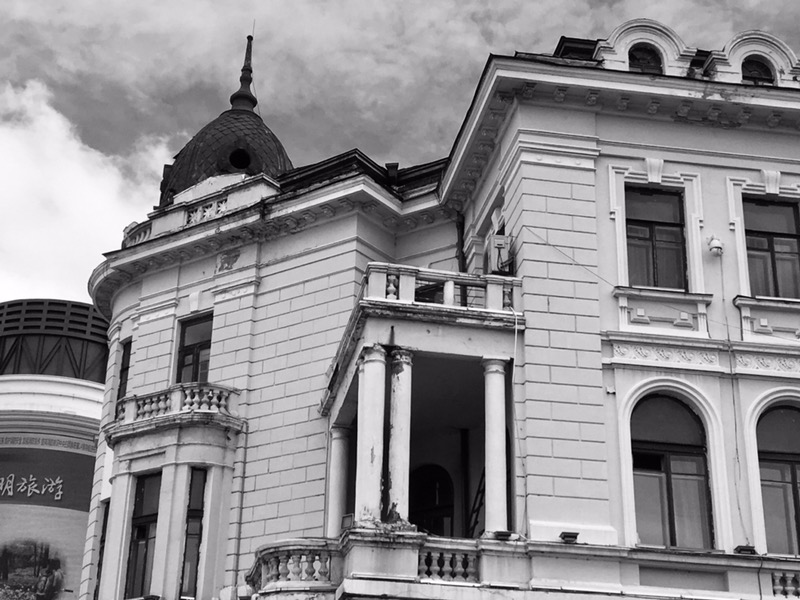
A Russian-style building in Harbin.

I am also responsible for finding at least three kinds of dried fruit, which people tend to pair with congee, tea, or dessert, so I step into the shade of a store selling dried goods. Flies buzz over crates of sunflower seeds, sweet dates, seasoned walnuts, sun-dried blueberries. The store is run by an elderly couple, who sit toward the back, fanning themselves in the dimness.

I ask about ten questions. What kind of fruit is this? Are these almonds? How do you sell them? They answer enthusiastically. I pass a hand over a bin of dried blueberries, come back with a palm full of dust.

“Everything is more expensive now,” the wife tells me. “This is not the best season for selling.”

I buy a bag of sweet dates — which the husband tells me sells best — and start eating them on my way back to my dorm. They’re extremely sweet. Weeks later, while eating them, I pry a date to find a shriveled, burnt larva curled at its center. I spit out the sweet things in my mouth, throw out the entire bag.


There are two kinds of translations you must complete in order to fully grasp the nuances of another language. Besides translating actual words, there’s some translation that goes into adapting your habits, thoughts, and actions into ones suitable for a different culture. Who I am in China differs from my American counterpart: I try to be more agreeable, question authority figures far less.

In a newspaper-reading class, per my teacher’s instructions, we parrot sentences from the article we just read. She holds up each phrase on a flashcard, and we read: Expand social security coverage. Eagerly await the improvement of national policy. Challenges the government must tackle. Build a harmonious society. These bits of language are insights into how a culture considers certain issues, or perhaps how it is conditioned to consider issues. There is never a policy that proves a failure (it merely needs improvement), never an issue that cannot be tackled.

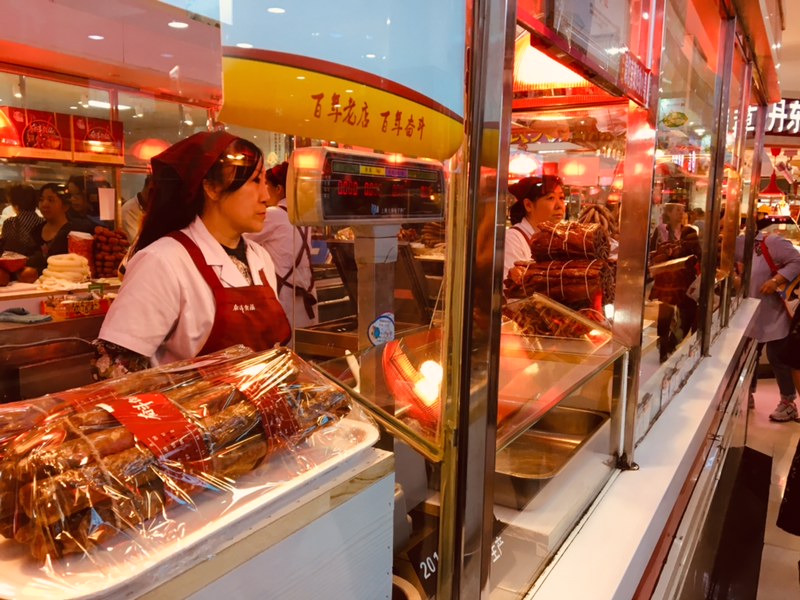
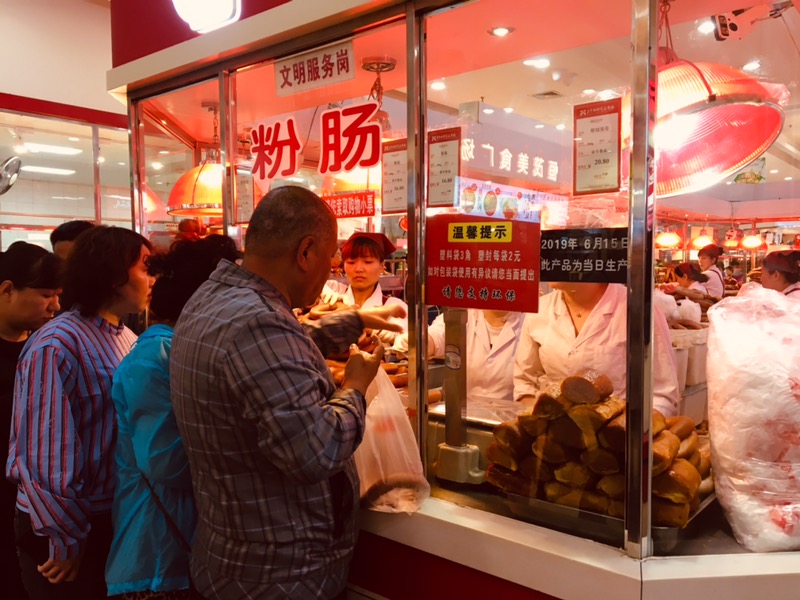
Vendors selling Harbin specialties, such as hongchang, a Russian-inspired sausage, at a food market.

At the shichang, I am asking another fruit vendor many questions. How much does this watermelon cost? Cherries? This melon? He weighs all the fruits for me, but I am not interested in buying anything, just learning Mandarin in conversation.

“Where are you from?” he asks.

I think about saying I’m Chinese to quell further small talk, but I say, “I’m American.”

I am suddenly, uncomfortably aware of how I don’t fit in this particular landscape. I am uncomfortable with the fact that we are a group of non-Chinese students practicing Chinese with street vendors. Many of us will come back to China for business, international relations, financial opportunities. It would benefit the growth of the Chinese economy, but would not benefit people like this man, a man who likely travels every day from a low-income, rural area into this city to sell his fruit before it rots.

Living in a foreign country comes with a kind of responsibility of acknowledging the space you’re in, how you might not fit in it perfectly. I’ve heard from a lot of Chinese Americans that going to China triggers a sort of identity crisis. The people, the traditions, and language are familiar, yet there’s something alien — as if you were looking at the face of relative you haven’t seen in years, or hearing the first lines of a ancient poem you’ve long forgotten. Or maybe you are the alien — something that could belong in the landscape from a distance, though not at close range.

I decide to buy a watermelon from the vendor. It’s heavy. I carry it back with me, never eat it.

Standard

GHOSTS OF BEIJING

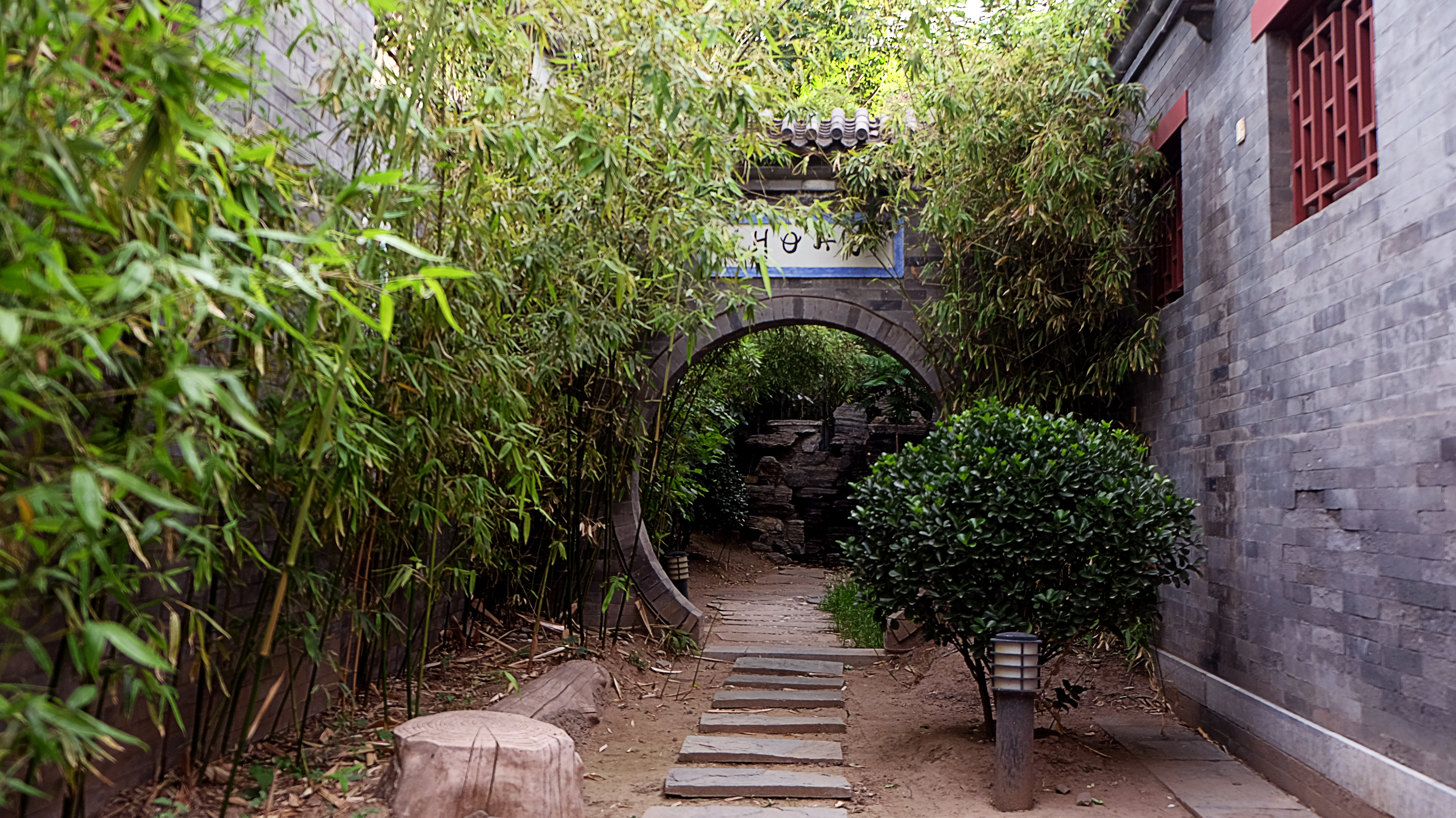
A courtyard inside one of Beijing’s traditional siheyuan homes. Siheyuan — “quadrangle” in Chinese — are surrounded by four different houses.

The door to the market is shuttered, its insides swept dark. I keep looking beyond the glass, wondering where everything has vanished. The signs on the building’s exterior have been stripped away. All that remains is a ghost facade, faint silhouettes of Chinese characters: It was once the Wudaokou Costume Market.

A Baidu search tells me that the wholesale market — where three floors of vendors once sold cheap jewelry, knockoff Adidas track pants, imitation Diesel jeans, graphic t-shirts adorned with poorly translated English, handbags, and more — was closed at the end of January this year. This is bad news. I had planned to spend my first afternoon in Beijing bargaining for jewelry. This ring for twenty-five RMB? That’s far too much. Let’s do ten.

I lived in this part of Beijing before while attending sixth grade at a school near the outskirts of the city, yet little is familiar. There’s no trace of the market so visceral in memory: the first floor that sold electronics; the second a maze of purses lined neatly on hangers, vendors shouting out increasingly favorable prices as you walked farther away. A store closing is expected after leaving a country for six years, but something about this closure is so shockingly urgent, almost hasty, as if the city was in a rush to rid itself of this space, like ripping a splinter from flesh.

Mao Zedong once said that to be a builder of a new world, one must be a critic of the old world. China is diligently razing its old world; now, only three of Beijing’s once-ubiquitous wholesale markets remain, all of which cater largely to tourists and foreigners. The market closures are part of the city’s efforts to eliminate non-essential businesses, which are dubbed “big city ills.” Vendors are forced to relocate to marketplaces that can be up to an hour away by train from Beijing, where they often struggle to maintain business. Nonetheless, the empty wholesale markets in will soon contribute to the city’s new face. Many will be reconstructed as high-end shopping malls or cultural centers.

I’ve witnessed China’s rapid modernization in the form of Beijing’s changing landscape. The city looks futuristic now — the twisting CCTV building, gleaming high-rises of the financial center, the high-speed trains whispering through the country. I find a different space each time I step off the plane: One visit, there’s a cluster of hutong, the next, a new shopping district. One visit, there’s rickshaws, on another, a new subway line. One year, I see my grandfather, another year, I don’t.

In Beijing, I pass as a local until I start speaking, so I don’t speak, just take a bus to a nearby park — Yuanmingyuan. In the park are the ruins of a palace, burnt by the British and French during the Opium Wars. This city is different but its rhythms are familiar: I listen to a group of schoolchildren laughing in front of the cracked marble, to the swans honking in the ponds, to the sway of a migrant worker’s broom as she brushes rainwater toward the side of the street, only to watch it stream down again.


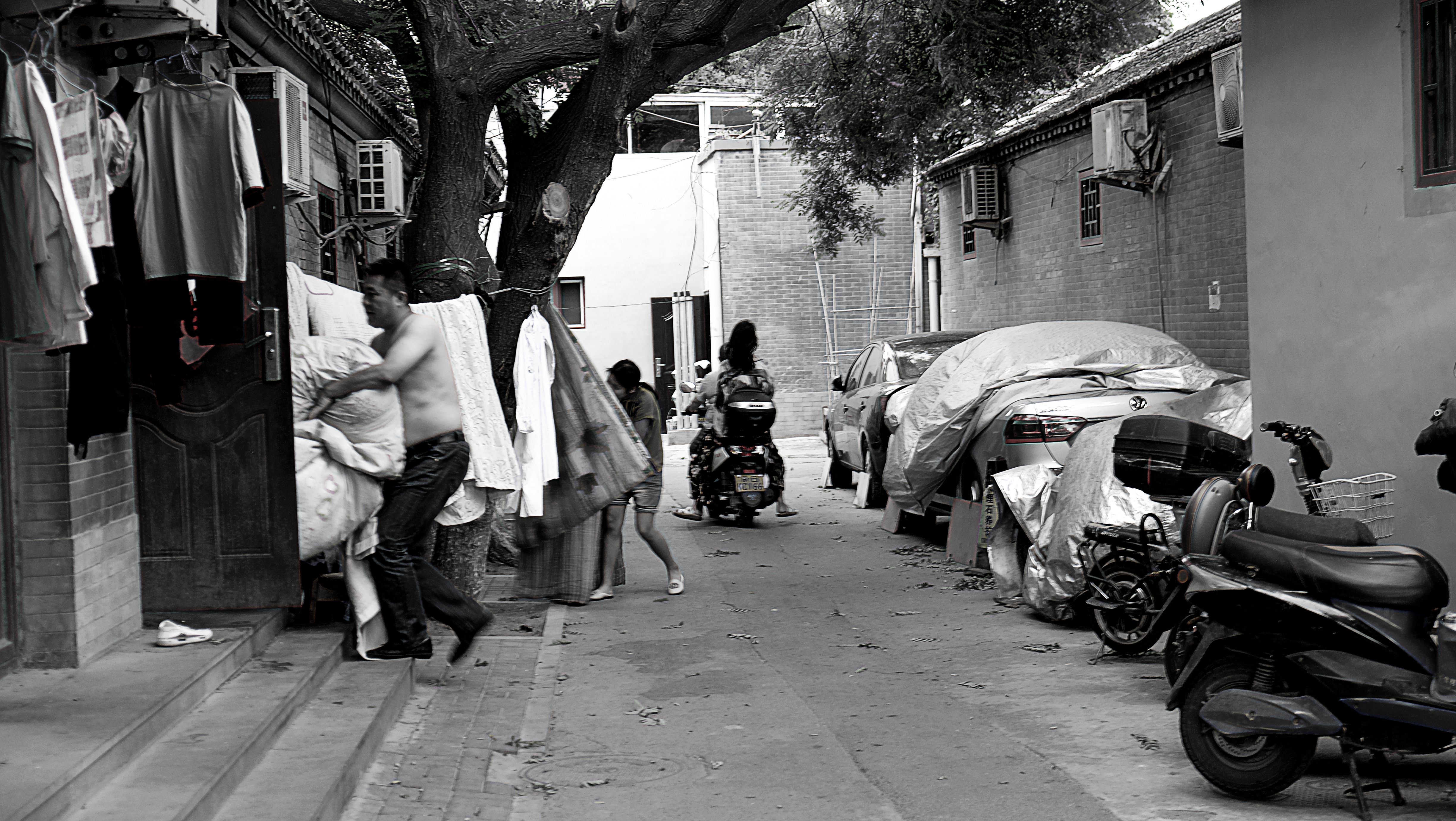
Two hutong residents gather their laundry from outside.

Ancient Chinese architects were obsessed with balance, harmony, and hierarchy, so it makes sense that the hutong of Beijing — traditional neighborhoods constructed during the Yuan dynasty — cocoon the Forbidden City, stretching around the palace like honeycombs. In imperial China, dignitaries and friends of the emperors lived in the hutong closest to the palace, while the poor remained in the outer rings.

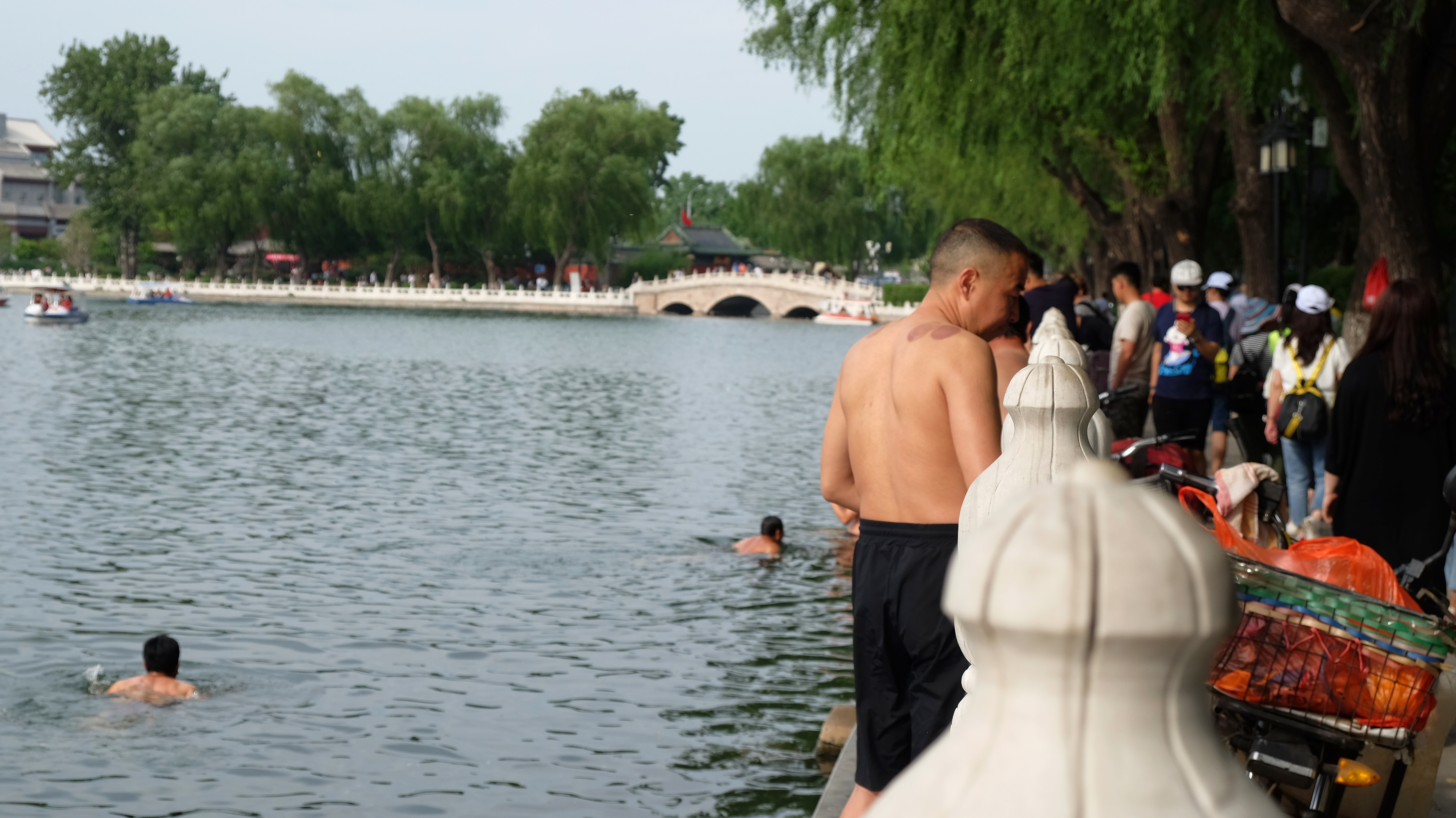
I’ve always thought that hutong are the best places to visit in Beijing, as they are some of the most social, community-based neighborhoods. Today I’m visiting Nanluoguxiang, a hutong near the old Drum and Bell Towers. A group of elderly women bring stools to the street, gossiping as their little dogs yap at each other. It’s windy, and, as a breeze starts to blow away linens hanging outside a home, a couple rushes outside to save them before they fly away. Later, at sunset, a dozen men cluster near the edge of Houhai, their bare backs covered in cupping marks. They wade into the lake and begin swimming.

Smash the four olds, the Chinese revolutionary saying goes. Old customs, old culture, old habits, and old ideas. Sweep away these ghosts and monsters.

The city had set out to demolish this neighborhood to make room for a new project, “Time Cultural City,” a themed shopping plaza. They decided to leave it after facing significant local protest. Mainly, the hutong survives because it is economically feasible: While the side streets contain the homes of local residents, who are generally elderly and lower income, the main street contains bohemian bars and cafes hidden in siheyuan courtyards, where foreigners, tourists, and young people drink and socialize.

The rest of Beijing’s hutong — for which profit-making opportunities are more scarce — don’t meet such favorable fates. Hutong homes — many of which have been passed down for generations — are often marked for demolition, and residents have no choice but to move to low-quality high rises outside the city.

I stop by a quiet rooftop café, where plants surround every table and cats wander among the patrons. There’s something about traveling alone that forces you to pay attention to everything a place presents about itself, how it chooses to share its history. I can’t help but sense the artifice in this hutong, so different from the city beyond its walls. The hutong is a calculated tableau of the past; the rest of the city lunges into the future.

The iconoclast artist Ai Weiwei, a controversial figure in China for his protest-inspired artwork, is notorious for his piece Dropping a Han Dynasty Urn. The work is a set of three photos: The first shows Ai clutching a genuine Han urn, considered a priceless antique; the second has the urn in midair, falling to the ground; the third shows the urn smashed into pieces at his feet. It suggests that what we consider valuable is subject to change at any given moment — that this change can be sudden, violent.

Beijing has a complicated relationship with its history, and it is perhaps more interested in erasing its ghosts and monsters than bringing them to light. Still, Beijing has remarkable control over the narrative of itself it presents to outsiders, something that becomes most evident to me in Tiananmen Square.

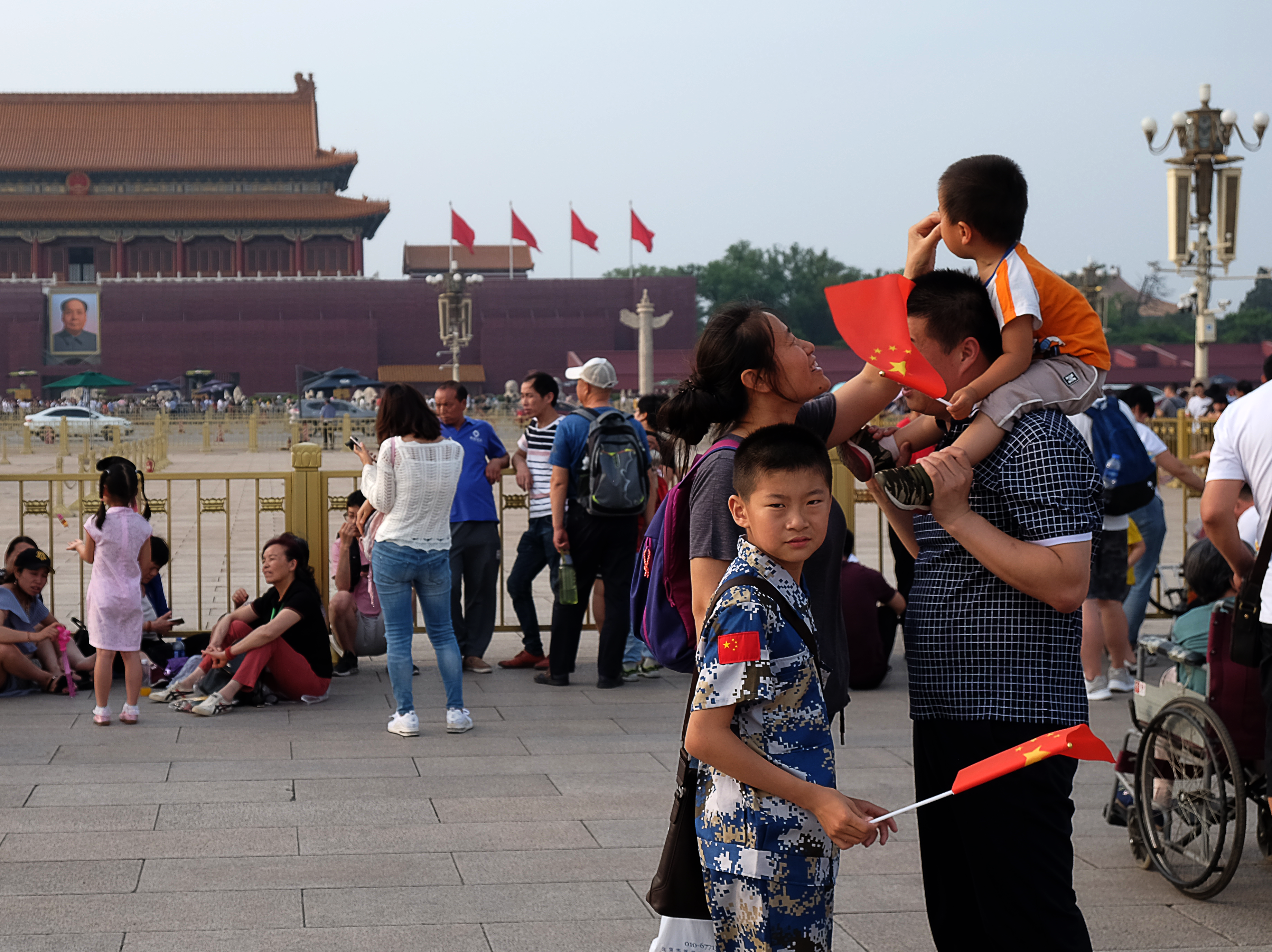
The guidebooks say to avoid the crowds at Tiananmen, but it’s hard to find many in its expansiveness. I am always struck by the vastness of the square, even by its overt displays of political power. The positioning of government buildings in front of a symbol of imperial China is far from subtle. Children wave Chinese flags; families snap selfies in front of Mao Zedong’s portrait.

A family stops in front of Tiananmen.

It’s an uncomfortable space. I am trying to find ways to document what the city chooses to forget. I am trying to find ways to photograph why and how it makes me uncomfortable — this gate of heavenly peace that, for much of the world, represents the political, controversial, and even brutal — when a couple guards approach me.

Mei nü, I saw you taking photos of us,” one says, stiff in his uniform. “You are not allowed to do that. We cannot be in any photos.” He watches over my shoulder as I open my camera, hit Delete.

“I’m sorry,” I say. “I didn’t realize.” Behind me, against the dusk, a worker removes a broom from her cart and starts sweeping.

Standard

LEAVING

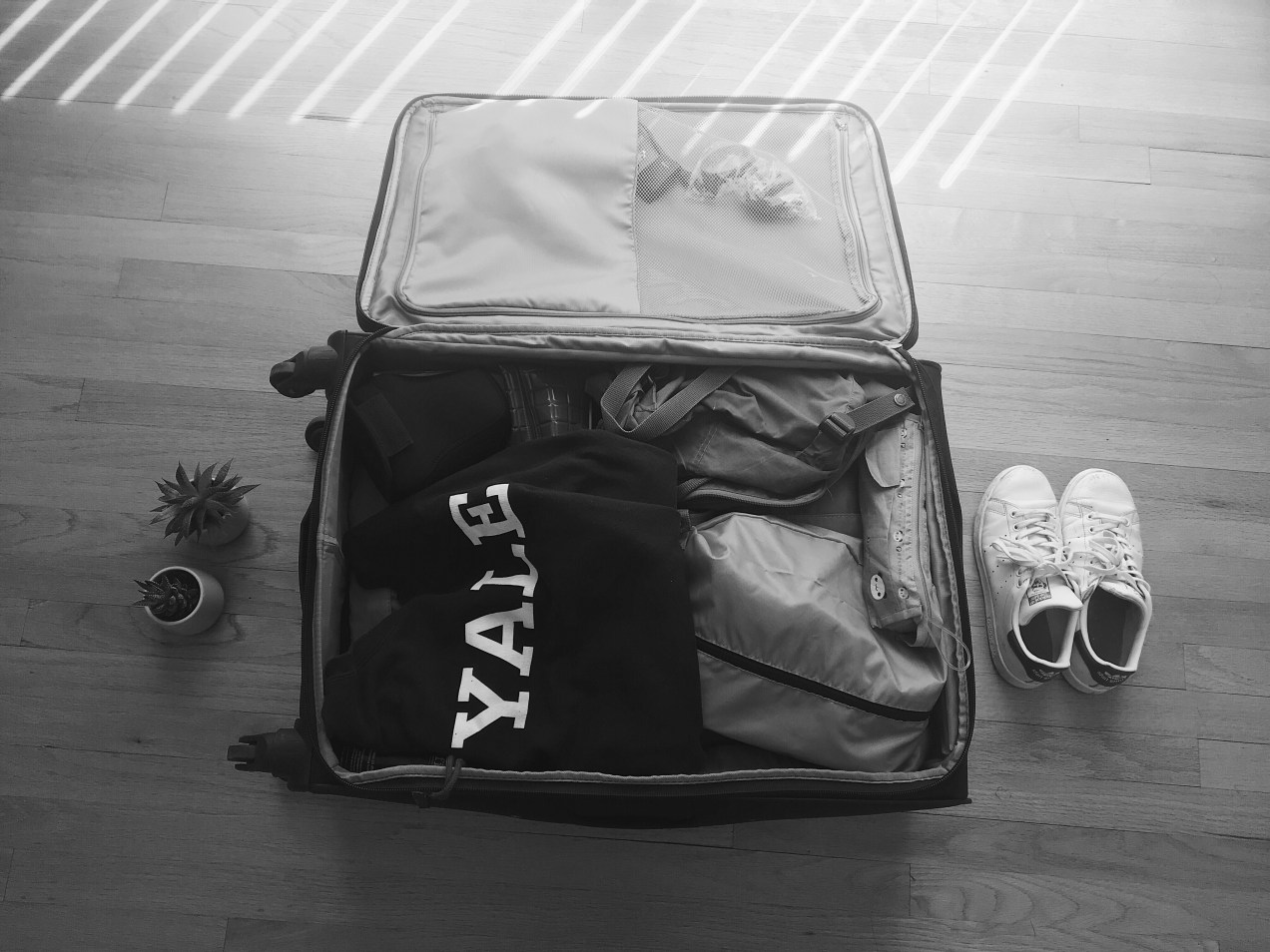
I leave for Beijing tonight. I have a brief layover in Zurich, Switzerland before I board a plane for China. I’ve heard that Swiss Air serves nice chocolates in lieu of the usual airplane pretzels — an amenity which I am very much anticipating.

I’m sightseeing in Beijing for a couple days before heading to Jinan, Shandong to visit a few relatives. I lived in Beijing for a bit when I was younger; there’s not much I haven’t seen, though I haven’t been there for years. I’m trying to find the best way to explore a city that’s already familiar, to maybe defamiliarize it in some way, or even just see as much as possible in 36 hours.

For now, I have to find someone who can take care of my plants!

Standard